
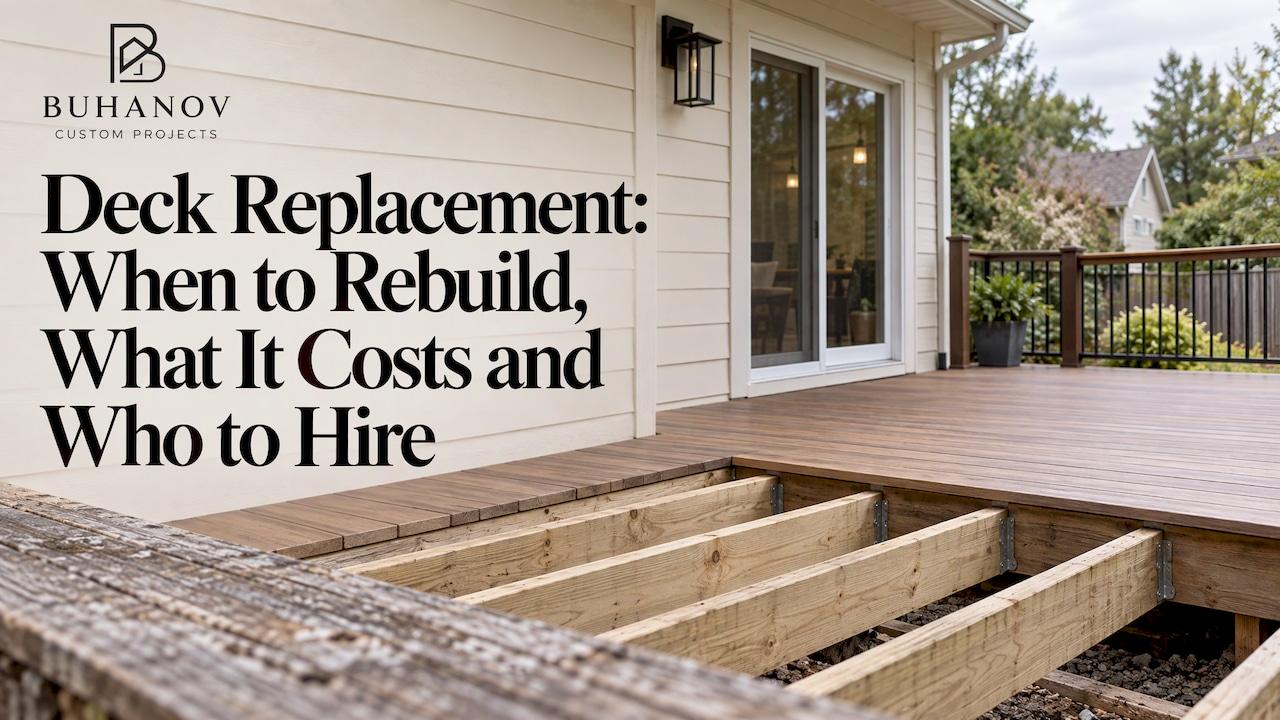
A deck is ready for replacement when the damage is in the structure, not just the surface. If the ledger (the board that bolts the deck to your house), the joists, the beams or the posts are rotted or loose, new boards will not fix it. The right contractor inspects the frame before quoting, puts the scope in writing, and stands behind the finished work with insurance and a warranty. At Buhanov Projects we build and replace decks for homeowners in Fresno and the Central Valley, with insured work backed by a warranty.
This guide shows you how to tell repair from replacement, what a replacement costs in the United States, which materials suit which budgets, what permits to expect, and what a solid contractor bid contains.
TL;DR
- Replace the whole deck when rot or damage reaches the ledger, joists, beams or posts. Replace only boards when the frame is sound and the wear is on the surface.
- Nationally, professional board replacement runs roughly $15 to $90 per square foot, and a new 20-by-20-foot deck is estimated at $16,000 to $24,000.
- Labor can exceed material cost, and the substructure, railings and stairs belong in the budget, not just the decking.
- Most attached decks need a permit and inspections, and California requires 42-inch guardrails.
- Compare written bids that state who pulls permits, what is included, and what warranty covers the work.
Table of Contents
- Repair, resurface or replace: three different jobs
- Signs your deck needs replacing, not repairing
- What deck replacement costs
- Is repair ever cheaper?
- Choosing materials for a replacement deck
- Permits, inspections and code
- What to ask a deck replacement contractor
- How Buhanov Projects handles deck replacement
- A realistic timeline
- FAQ
- Sources
Repair, resurface or replace: three different jobs
Homeowners often use "replacement" for three very different projects, and bids that look far apart are often bidding on different things.
- Repair: fixing specific problems, such as a few soft boards, a wobbly railing post or a loose stair stringer.
- Resurfacing: pulling off the old deck boards and railing and installing new ones over the existing frame. TimberTech's replacement guide distinguishes this from full replacement, where the structure, surface and railing all come out.
- Full replacement: demolition and a new deck built from the footings or ledger up.
The frame decides which one you need. Surface boards can be changed independently, but widespread deterioration in the framing points to a complete rebuild.
Signs your deck needs replacing, not repairing
The general rule from Bob Vila's repair-versus-replace guide is that significant rot or damage in several areas, on a deck near the end of its lifespan, favors replacement. Superficial splintering or fading on a deck with years left favors replacing boards or refinishing.
Here is what to look at.
The ledger and flashing
The ledger is where most serious deck failures start, because it carries load and is also where water gets in against your house. Look for soft wood, stains running down the siding, rust on bolts and missing or cracked flashing (the metal or membrane that sheds water away from the joint). A deck-to-house connection should have corrosion-resistant flashing so water does not reach the house's band joist, a requirement spelled out in one township's 2026 deck requirements that reflects standard practice.

Posts, beams and joists
Probe the bottoms of posts and the undersides of joists with a screwdriver. Wood that crumbles or lets the tip sink in easily is rotted. TimberTech's guide lists pervasive rot in joists, beams or posts as a reason for full replacement, while localized surface damage may be repairable.
Movement and bounce
A deck that sways, bounces or pulls away from the house is telling you the connections are failing. Loose railings and wobbly stairs deserve the same attention.
Appearance alone is a poor guide
Consumer Reports' May 2026 decking guide notes that cracks, dirt or mildew prompt a choice between refinishing and replacing, and that signs of an unsafe deck may not be obvious. A deck can look tired but be sound, or look fine and be rotted underneath. That is why an inspection of the ledger, framing, posts, flashing and connections matters more than how the surface looks.
If you see any of these, keep people off the deck until it has been inspected.
What deck replacement costs
Price depends on size, material, railings, stairs, the condition of the structure and local labor rates. Published national figures are a starting point, not a quote.
| Project | Published range | Source |
|---|---|---|
| Professional deck board replacement | $15 to $90 per square foot | Cost-guide figure cited in 2025 is for new builds; board-only estimates vary by material |
| New 20-by-20-foot deck (400 sq ft) | $16,000 to $24,000, based on $30 to $60 per square foot | NerdWallet, 2025 |
| Typical deck repair | $859 to $3,321, averaging $2,019 | Bob Vila, April 2024 |
| Wood decking materials | About $200 to $1,100 or more per 100 sq ft | Consumer Reports, May 2026 |
| Composite decking materials | About $300 to $700 per 100 sq ft | Consumer Reports, May 2026 |
| Plastic decking materials | About $525 to $1,200 per 100 sq ft | Consumer Reports, May 2026 |
The 20-by-20 figure is an estimate for a new deck, not a replacement quote. A replacement adds demolition and haul-away, and it can reveal framing or footing problems once the old deck is open. Those are exactly the items a good bid spells out.
Why labor matters as much as boards
Consumer Reports says labor for a new deck or for replacing worn planking can exceed the cost of the materials. A budget that only prices boards misses the supporting structure, fasteners, flashing, railings, stairs, permits, delivery and disposal. When two bids differ by thousands of dollars, compare their line items before comparing their totals.
A worked example
Take a 12-by-16-foot deck, 192 square feet. Using the national new-deck range of $30 to $60 per square foot, a rough planning figure is about $5,760 to $11,520. Whether yours lands low or high depends on whether the frame can stay, which material you choose, how many stairs you have and how much railing you need. Treat that as a budgeting range, then get a written estimate for your actual deck.
Is repair ever cheaper?
Yes, when damage is limited and the base is intact. Bob Vila's repair-cost guide lists size, material, labor and permits, delivery fees, type of damage, season and geography as the cost drivers, and says minor repairs can be simple while major structural work is best left to professionals.
A practical way to decide:
- Price the repair, including the safety work the inspection turns up.
- Price the replacement, or resurfacing if the frame is sound.
- Weigh the gap against the deck's age. Spending a large share of a replacement's cost to extend a deck that is near the end of its life rarely pays off.
If you are borderline, ask for both options in writing from the same contractor so you are comparing like with like.
Choosing materials for a replacement deck
Wood
Pressure-treated pine is the lowest-cost route and is the standard for structural parts that touch the ground or sit exposed to weather. Fine Homebuilding's deck project guide covers finishes, annual maintenance, cleaning, refinishing and replacing damaged planks, and its central point is that durability is an ongoing routine, not a one-time decision. Plan on regular cleaning and sealing if you choose wood.
Composite
Consumer Reports describes composite decking as wood fiber and plastic, generally needing no staining. It is heavier and more expensive than pressure-treated pine, and slip, stain and mildew resistance varies by product. The heavier boards are one more reason to confirm the frame is sound before you commit.

A sensible combination
Many homeowners keep the budget in check by rebuilding the frame with pressure-treated lumber and choosing decking boards to match how much upkeep they want. Because the frame is hidden once boards go on, this is the place not to cut corners.
Heat in the Central Valley
Fresno summers put decking in direct sun for months. Shade, color and board type affect how hot a surface gets underfoot, so talk through the exposure of your yard before you pick a material.
Permits, inspections and code
A replacement is not always exempt from permitting just because a deck already stands there. Rules are set by your city or county, so confirm with your local building department.
Two examples show the pattern:
- One Pennsylvania township's 2026 deck requirements require a permit application with a site plan and framing plan, and list footing, framing and final inspections.
- In Fresno, a permit guide for the city describes an exemption only for decks not exceeding 200 square feet, not more than 30 inches above grade, not attached to the dwelling and not serving a required exit door. Anything outside that generally needs a permit.
California also differs from much of the country on guardrails. A state-by-state summary reports that guards are required where a walking surface sits more than 30 inches above the grade below, and that California requires them to be 42 inches high rather than the 36-inch national baseline.
A step the law gives to the building department is part of the process, not a hurdle to skip. Ask any contractor who applies for the permit, who schedules the inspections and whether the price includes the fees.
What to ask a deck replacement contractor
NerdWallet's guidance is to compare at least three bids from licensed, bonded and insured deck contractors. Use this list when you read them.
- License and insurance. In California, confirm the contractor's license and that liability coverage is current.
- Scope. Does the bid include demolition, haul-away, footings, framing, flashing, decking, railings, stairs and cleanup?
- Permits. Who obtains them and are the fees included?
- Materials. Which brand, grade and color, and what is the delivery arrangement?
- Warranty. What is covered, for how long, and is it for materials, workmanship or both?
- Schedule. Expected start date and duration.
- Payment terms. How much is due at signing, at milestones and at completion.
- References. Recent projects similar to yours.
Prices also shift with season, so ask whether a start date in a slower month changes the number.
How Buhanov Projects handles deck replacement
Decks, fences and custom projects are part of what we build, alongside finish carpentry, flooring, painting and repairs. That mix matters on a deck, because the details that make one look finished, such as trim, railing connections and clean edges, are carpentry. Our approach is built around clear estimates, durable workmanship and a clean final presentation, and our work is insured and backed by a warranty.

If you own a deck in Fresno, Clovis, Madera, Visalia or nearby, you can request an estimate through our Fresno page or the main site. Our team plans the scope with you before work begins, so the question of repair, resurfacing or full replacement gets answered in writing against your actual deck.
A realistic timeline
Every project differs, but replacement generally follows this order:
- Inspection and scope. The frame, ledger, footings and connections are checked and the options are priced.
- Permit. Plans are submitted where required, and approval times vary by city.
- Demolition and haul-away. The old deck comes out and the ledger area is exposed.
- Footings and framing. Any hidden damage found here can change the scope, so a written process for handling it is worth having.
- Inspections. Footing and framing inspections happen before the surface goes on.
- Decking, railings and stairs. Surface, guardrails and steps are installed.
- Final inspection and cleanup. The permit is closed out and the site is cleared.
The frame stage is where surprises show up. Ask in advance how the contractor handles additional findings and whether changes need your written approval.
FAQ
How much should it cost to replace a deck?
National estimates for a new deck run about $30 to $60 per square foot, which puts a 20-by-20-foot deck at roughly $16,000 to $24,000. Your price depends on material, size, railings, stairs and the condition of the frame. A written estimate for your own deck is the only number that matters.
Is it cheaper to repair or replace a deck?
Repair costs less when damage is limited and the frame is sound. Typical repairs run around $859 to $3,321 in one 2024 guide. If the ledger, joists, beams or posts are rotted, repairs add cost without making the deck safe, and replacement is the better investment.
Do I need a permit to replace my deck?
Often yes. Many cities exempt only small, low, detached decks, and attached decks typically need a permit and inspections. Check with your local building department, and ask your contractor who handles the application.
What is the difference between resurfacing and replacing a deck?
Resurfacing installs new boards and railing over the existing frame. Replacement removes the structure too and rebuilds it. Resurfacing only makes sense when the framing, ledger and posts have been confirmed sound.
Sources
- Solved! Should I Repair or Replace My Deck? (Bob Vila)
- Deck Repair Costs: A Homeowner Budgeting Guide (Bob Vila)
- Ultimate Decking Buying Guide (Consumer Reports)
- The Cost to Build a Deck in 2026 (NerdWallet)
- Deck Replacement: When It's Needed and What to Do (TimberTech)
- Decks project guide (Fine Homebuilding)
- Deck requirements 2026 (Palmer Township, Pennsylvania)
- Deck permit in Fresno, CA
- Deck guardrail height and permit rules by state